
Indonesia’s G20 Presidency and the Legacy of Islamic Economics & Finance
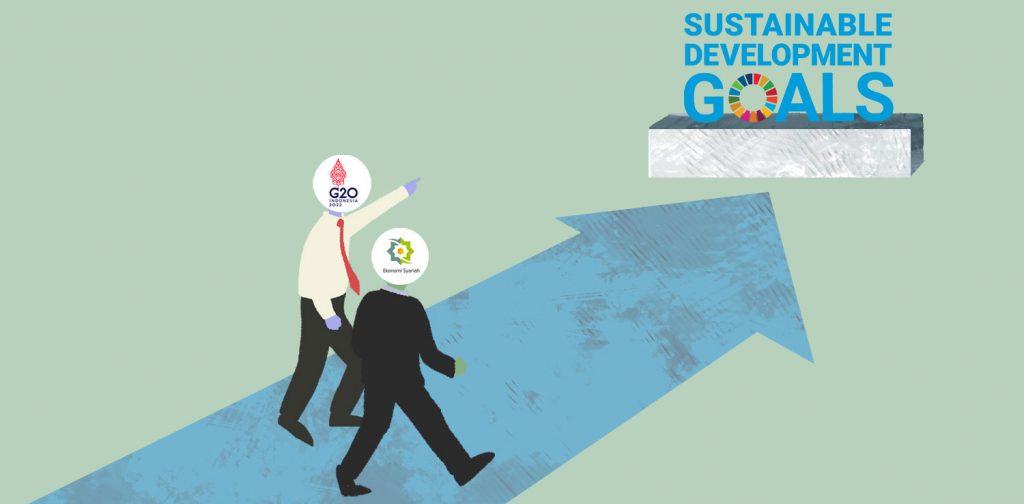
Illustration by Inez Kriya
Sunday, October 31st, 2021, was a historic day for Indonesia. At the closing event of the G20 Summit in Rome, Italian Prime Minister Mario Draghi handed over a hammer to Indonesian President Joko Widodo to symbolically pass the baton of the G20 Presidency. Joko Widodo hit the hammer in acceptance of Indonesia’s G20 Presidency in 2022.
Working together towards sustainability
It is worth noting that Indonesia’s G20 Presidency brings forth the theme “Recover Together, Recover Stronger”. Through this theme, Indonesia invites the world to support each other shoulder to shoulder and work together to recover from the COVID-19 pandemic and grow stronger. Indonesia’s G20 Presidency is committed to inclusive, people-centered, environmentally friendly, and sustainable growth.
This theme fits Indonesia’s values and characters like a glove, especially the concept of gotong royong. Gotong royong can be roughly translated as working together. It is necessary for our efforts to achieve Sustainable Development Goals. COVID-19 pandemic has knocked down almost all sectors of society and, with it, reignited the spirit of gotong royong within us. In a world of VUCA (Volatility, Uncertainty, Complexity, Ambiguity), gotong royong becomes a beacon in the dark for Indonesia and the rest of the world.
Islamic Economics & finance for sustainable development
As a country with the biggest (11.92%) Muslim population in the world, Indonesia has a very high potential to contribute to the growth and development of the global economic ecosystem through Islamic economics & finance. Indonesian President Joko Widodo has been one of the leading figures who embrace the idea, and he has the chance to turn this positive opportunity into reality as the legacy of Indonesia’s G20 Presidency. This statement comes not without facts and data.
After his inauguration in 2014, President Joko Widodo formed KNKS, the National Committee of Islamic Economics. He then perfected it to KNEKS, the National Committee of Islamic Economics & Finance, at the beginning of his second Presidency in 2020. KNEKS is led directly by President Joko Widodo and Vice President KH Maruf Amin. The Minister of Finance, Sri Mulyani, was appointed as the Secretary of KNEKS and the Head of The Indonesian Association of Islamic Economists (IAEI). Meanwhile, Erick Thohir, the Minister of State-Owned Enterprises (BUMN), was chosen to lead the Sharia Economy Society (MES).
Under Erick Thohir, three state-owned Islamic banks were consolidated into one Bank Syariah Indonesia (BSI), or Indonesian Islamic Bank. BSI is projected to be in the top 5 biggest banks in Indonesia and the top 10 biggest Islamic banks globally. Step by step, Indonesia starts to show its achievement in Islamic Economics & Finance, such as by taking first place in the Islamic Finance Country Index (IFCI) from the Global Islamic Finance Report 2021.
This achievement is an important reflection of our place within the national and international context. It indicates that Indonesia’s Islamic social finance sector is the most dynamic one in the world. Together, we must support the development of the Islamic socio-finance industry and green economy to achieve the SDGs.
At its core, the purposes of sharia “maqasid sharia” in Islamic Economics & Finance is in line with the sustainable development agenda and vice versa. Maqasid sharia encourages us to protect our religion, soul, mind, descendants, and property; it is in sync with the three pillars of sustainable development: economic development, social progress, and environmental conservation.
BSI as a game-changer
Naturally, Islamic Economics and Finance may become the hope of our economy in the present and the future. As of August 2021, the Islamic banking industry in Indonesia is performing better than its conventional, national counterpart. It showed significant YoY growths in asset, financing, and third-party funds. The values and characteristics of Islamic Economics & Finance fit those of the SDGs, making it imperative to peruse it to achieve the SDGs in Indonesia and inspire the world to do the same. This concept should be the most important point Indonesia delivers in its G20 Presidency.
Furthermore, Indonesia must show its commitment to the principle of sustainable development, “No One Left Behind”. This principle must answer the procedural justice query of how far all sectors can equally be involved in the sustainable development agenda. It also must answer the substantial justice query of how well this sustainable development agenda can solve citizens’ problems.
Poverty reduction and community welfare are the keys to answering those queries. Strengthening Islamic Economics & Finance can parse how it can happen. As the intermediary fundraiser and distributor, BSI can contribute through productive financing that helps customers fund their enterprises with profit-sharing contracts (or akad, in Islamic economics terms).
Furthermore, Islamic Economics & Finance has social instruments such as zakat, infaq, sadaqah, and waqf that are useful to lessen economic inequality. There is 500 trillion IDR worth of potential in this system, and only 75 trillion IDR has been realized. This is the potential BSI focuses on in developing its ecosystem.
As the only bank that President Joko Widodo declared its establishment at the Merdeka Palace, BSI can truly be a game-changer on these issues. Hope skyrocketed again as BSI acquired the principal license of a representative office in Dubai. BSI is grounded on earth and seeking the sky for ummah (people) and the nation.
Translator: Nazalea Kusuma
Editor: Marlis Afridah
To read the original version of this article in Indonesian, click here.
Arief Rosyid Hasan
Arief is the Vice Head of Sharia Economy Department of the Indonesian Chamber of Commerce and Industry (KADIN) and an Independent Commissioner of Bank Syariah Indonesia.

YOUR TITLE FOR CONDITION 1
YOUR BODY TEXT FOR CONDITION 1
 Electric Vehicles Roam the Roads of Kenya
  Come Back Stronger: Building Philippines’ Resilient Economy Post-COVID-19
  Inside Experian’s Sustainability Journey: An Interview with Chief Sustainability Officer Abigail Lovell
  How Protection Law and Global Commitments Can Accelerate China’s Wetland Conservation
  How Biotechnology Can Support Food Security and Energy Transition
  Thinking Through Product Life Cycle and Good Practices for Sustainability: An Interview with David Croft from Reckitt
  Test Custom Feature Image
  Test premium post