
Interdisciplinary Research: In Search of the Complete Truth

Illustration by Irhan Prabasukma.
There is a famous anecdote about six blind men and an elephant. In the story, each man touched a different part of an elephant, unable to see what he was touching. Those six men then debated whether it was a wall, a hunk, or a piece of cord. They were only able to uncover the truth when they collaborated and shared their different perspectives and experiences. In science and research, this is the interdisciplinary approach.
In general, there are three core arguments in favor of interdisciplinary research. Firstly, traditional single-discipline research is not suitable for tackling contemporary complex problems. Secondly, discoveries and innovations of science and research are more prone to occur at the intersections of multiple scientific disciplines. Lastly, collaborations between researchers of diverse disciplines yield mutual benefit, extending their knowledge boundaries.
Case Study: Malnutrition and the Economic Paradox of Sylhet, Bangladesh
The importance of interdisciplinary research in Bangladesh’s context can be discussed through the child malnutrition problem in Sylhet. According to the latest 2017-18 report of the Bangladesh Demographic and Health Survey (BDHS), Sylhet’s rates of underweight and stunting were 33% and 43%, respectively, the highest in Bangladesh. However, the Household Income and Expenditure Survey (HIES) 2016 says the poverty rate in Sylhet is among the lowest in the country.
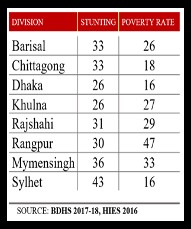
Economic indicators say that Sylhet should be considered a rich division due to the many people from the Sylhet division who live and work abroad and contribute to the economy by remittances. People of urban Sylhet are mostly rich. Meanwhile, the scenario in rural areas is the opposite, especially in the haor areas and tea fields.
The Sylhet region also faces nutrition and food security shocks caused by climate change. Every year, climate change-induced hazards such as untimely excess rainfall cause extensive damage to seasonal crops, which results in inadequate availability of minimum nutrition for the local people. The geographical location of Sylhet is also challenging for implementing intervention programs. Thus, to find the best understanding of this Sylhet phenomenon, we need an interdisciplinary research approach that will allow us to identify common causes and solutions.
A Modern, Complex World
Our modern world is extremely connected; consequently, we live in a more complex world than ever before. Nowadays, most of the challenges we face are an outcome of several interconnected phenomena and are too intricate to be handled through conventional disciplinary pathways. Public health disasters, climate change, political crises, food insecurity, water shortages, energy crises, poverty, gender inequality, and economic recession are only some of them, among many others.
Climate change issues cannot be solved by climatologists alone; health researchers won’t be able to get rid of the preventable diseases by themselves; economic experts won’t singlehandedly eliminate poverty; and if we want a hunger-free world, food scientists will not be able to do it alone. We must work together.
Interdisciplinary Research, Climate Change, and Sustainability
Let’s paint a picture: as humankind develops, we need more space to live in, more food to eat, more infrastructure, more medical treatment facilities, more money, more energy, more power, and so on. These increased needs impact nature, people, and our relationships with both of them. Prioritizing discipline purity and only utilizing a single disciplinary approach to these issues would make it near impossible to find a comprehensive solution.
All problems mentioned above stem from the three main aspects of sustainability: environment, social, and economy. Unfortunately, there is a common misconception that climate change and sustainability are merely environmental issues when they should be thought of as a system of several interrelated components.
For climate change, we have the challenge of decreasing carbon emissions and meeting the targets of the Paris Agreement of reaching net-zero carbon emissions worldwide by 2050 and limiting global warming to 1.5°C. For sustainability, we want to find a way for people to meet their needs and prosper without compromising nature for future generations. The UN’s Sustainable Development Goals (SDGs) – with 17 Goals to achieve by 2030 – act as a blueprint to end poverty while balancing the three aspects with a spirit of collaboration across sectors and stakeholders.
Interdisciplinary research would mean collaborative efforts from different fields and disciplines to figure out comprehensive solutions to the complex problems of our modern world. Still, this approach has many practical challenges; interdisciplinary research should always be conducted within context so it can generate an understanding that is the closest to the complete truth.
Editor: Nazalea Kusuma

Akhtaruzzaman Limon
Akhtaruzzaman Limon is a Research Associate at the Bangladesh Institute of Governance and Management (BIGM).

YOUR TITLE FOR CONDITION 1
YOUR BODY TEXT FOR CONDITION 1
 Electric Vehicles Roam the Roads of Kenya
  Come Back Stronger: Building Philippines’ Resilient Economy Post-COVID-19
  Inside Experian’s Sustainability Journey: An Interview with Chief Sustainability Officer Abigail Lovell
  How Protection Law and Global Commitments Can Accelerate China’s Wetland Conservation
  How Biotechnology Can Support Food Security and Energy Transition
  Thinking Through Product Life Cycle and Good Practices for Sustainability: An Interview with David Croft from Reckitt
  Test Custom Feature Image
  Test premium post