
Tiktok & “Green Influencers”: Can They Make an Impact?
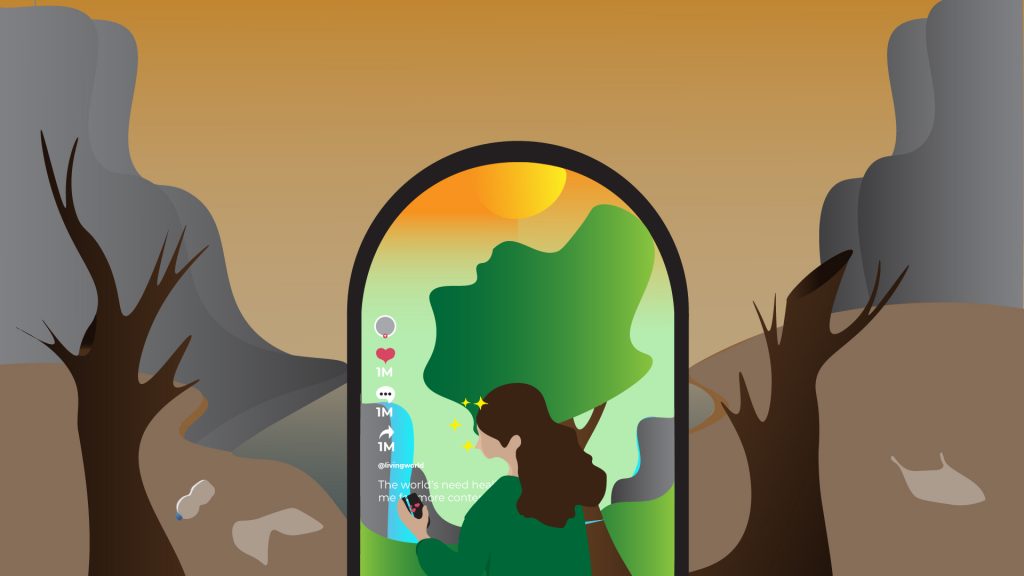
Illustration by Irhan Prabasukma
Digital activism is a topic that has often been discussed in recent years, what with how #MeToo and #BlackLivesMatter sweep the world. While those movements focus on sexual harassment and racism, the environmental movement is no stranger to the Internet. More and more grassroots organizations are going online and raising awareness. Among the mainstream public, veganism, the environmental impact of fast fashion, and sustainable living are common topics.
Twitter has been the platform most associated with social movements in the past years. However, with the recent rapid rise of Tiktok, environmental content on the platform has become a force to be reckoned with. Videos under the hashtag #climatechange have racked up 1.4 billion views, #globalwarming have gained 810.3 million views, and those under #sustainableliving have a total of 398.2 million views so far.
While approaches vary, climate video creators tend to utilize aspects of the app that encourage virality the way memes do—posting short videos that rely on music and captions and are later replied to, mimicked, and reworked by other users. The more interactions a video garners, the more it’s distributed to a broader audience.
Although these features help activist creators reach a wider audience, activism with virality as its basis has flaws. It can make a social movement be seen as a trend, something to care about only when it’s popular at the moment. It can lead to “clicktivism” and virtue signaling.
Clicktivism (also known as “slacktivism”) refers to activism that is done online, commonly through liking, sharing, retweeting posts, participating in online petitions, etc. In the earlier discussions regarding digital activism, clicktivism was seen as an act that involved minimal effort, was not impactful, and was frowned upon.
However, others have pointed out that although clicktivism may not follow the traditional pattern of socially impactful work, networked publics work differently. It can cause quite a stir and be meaningful in its way. The Internet gives power to marginalized people, who might not have as much agency offline, to speak up and be heard.
More and more journalists and activists have started to speak up against the use of the word “slacktivism.” They explain how the term shames people who have just started caring about an issue. Everyone needs to start somewhere, and we should not discourage them by expecting too much too early.
According to the Open Society Foundations, “digital technology is more likely to activate the politically inactive than to deactivate the politically active.” This can be seen by the amount of youth who have started speaking up about environmental issues on Tiktok, an app dominated by Gen Zs.
“Showing They Care (Or Don’t): Affective Publics and Ambivalent Climate Activism on TikTok” is a research conducted by Samantha Hautea, Perry Parks, Bruno Takahashi, and Jing Zeng. It states, “they (adolescents and early adults) might not clearly grasp the causes and impacts of rising global temperatures and might not offer concrete, practical solutions, but they form a networked atmosphere of concern that is influencing at least one generation’s orientation toward public affairs.”
Youth activists and Tiktok creators also understand the importance of diverting away from narratives that serve to shame. EcoTok, a young collective that shares green content on Tiktok, has addressed the issue of shaming in environmental circles. All too often, people are too focused on upholding an impossibly perfect standard for themselves and others trying to be eco-conscious.
Abbie Richards, one of the founders of EcoTok, has also talked about the importance of shifting away from “eco doom”. “Eco doom” and similar narratives try to make politically inactive people care about the environment by saying that “the world is dying” and that “we are doomed”. These narratives might backfire and only invoke feelings of guilt, shame, and uselessness as if there is no solution.
When it comes down to it, what matters is constant care, consistency, and willingness to learn. Everyone has to start somewhere, and for many, that might just be TikTok. Digital activism has a part to play, and “green influencers” should know their power and limits in planting the seeds. Effective digital activism should encourage growth in their audience that then translates to real-life actions.
Editor: Nazalea Kusuma

Tia Hanifa
Tia Hanifa is a Reporter at Green Network Asia. She graduated from Universitas Indonesia with a bachelor's degree in Communications (Media Studies).

YOUR TITLE FOR CONDITION 1
YOUR BODY TEXT FOR CONDITION 1
 Electric Vehicles Roam the Roads of Kenya
  Come Back Stronger: Building Philippines’ Resilient Economy Post-COVID-19
  Inside Experian’s Sustainability Journey: An Interview with Chief Sustainability Officer Abigail Lovell
  How Protection Law and Global Commitments Can Accelerate China’s Wetland Conservation
  How Biotechnology Can Support Food Security and Energy Transition
  Thinking Through Product Life Cycle and Good Practices for Sustainability: An Interview with David Croft from Reckitt
  Test Custom Feature Image
  Test premium post